
How to Get Rid of Bed Bugs – What Actually Works
Are you looking for a step by step guide of how to get rid of bed bugs on your own? Do you think that you can’t afford a professional bed bug exterminator? You are in the right place.
I hear from customers every day who tell me all about the methods that they have used to try and get rid of the bed bugs for good. I have learned from years of experience what works and what doesn’t. I have learned this from my own personal experiences with bed bugs, and every horror story I hear from callers.
People call in and they are just beside themselves, sometimes even crying. They have tried every method. They have spent hours, days, weeks, and even months trying to eliminate the bed bugs – and failing. They have spent hundreds of dollars on traps, mattress covers, and sprays. They have lost so many nights of sleep and endured the unbearable, itchy bites. They often develop anxiety and even depression from this traumatizing situation.
Don’t let that be you. Here I will discuss all of the things that do not work. I will share with you the best and most effective ways to exterminate the bed bugs for good.
Free Honest Bed Bug Advice – Schedule A Call
Talk to our most experienced bed bug technician for free honest bed bug advice, schedule a time to speak with Sean below.
Have You Seen Any Bugs Or Only Bites?
Have you seen any bed bugs, or are you only getting bitten by some unknown bug? We get so many calls from customers who are getting bitten by something and immediately assume it is bed bugs. Either that or they went to a doctor to discover the cause of their itchy bites and the doctor or nurse “tells than its bed bugs” based on the bites.
Mosquitoes Drink Blood Like Bed Bugs
There are several other things that could be biting you besides bed bugs. One of the most common bugs that bite and produce a similar reaction is mosquitoes. For most people, you will react the same way to bed bug bites as you do to mosquito bites. Learn more about bed bug bites here.
Bird Mites or Rodent Mites
If you have not seen any mosquitoes either and you are sure it is not that, then it could be something else. It could be bed bugs, or it could be some kind of mite. One of the most common biting mites are bird mites aka fowl mites. The second most common biting mites are rodent mites. Either type of mite are nearly invisible to the human eye. For many years we thought that the customers who were getting bitten by an invisible bug, we thought that they may be experiencing a mental health issue – or having a bad reaction to medication or detergent. We now have portable, powerful microscopes that we use to identify mites. Since we have encountered this so often since 2012 we have developed an effective mite treatment, contact us for a free inspection.
Are You Even Sure it is Bed Bugs? Recognize an Infestation
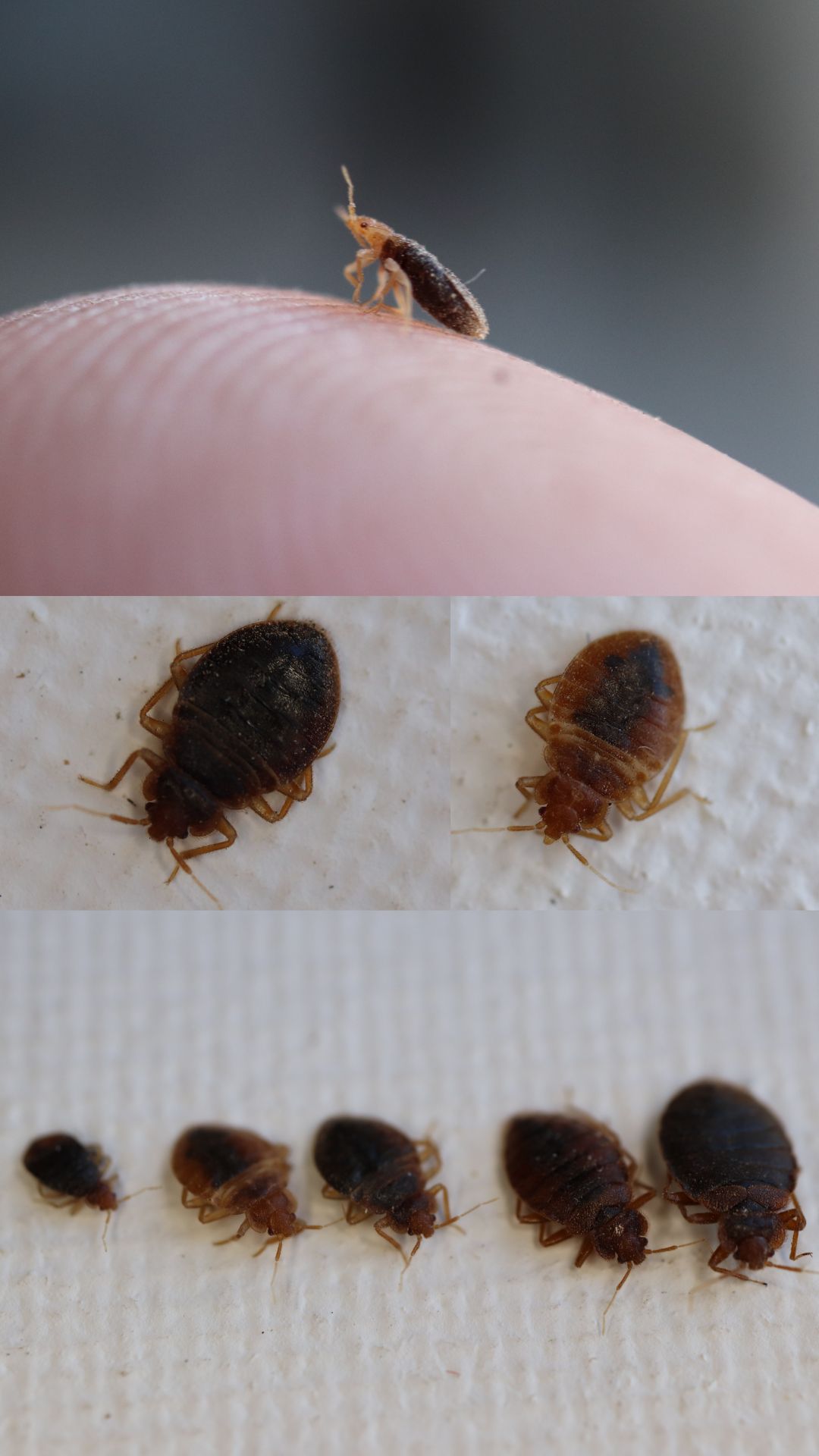
First, you need to make sure that it is in fact bed bugs that have infested your home. To identify bed bugs, make sure the bug you have found has these characteristics. Take a look at more pictures of bed bugs here.
- Bed bugs are small, usually less than a centimeter.
- They are oval shaped.
- They are flat and have six legs.
- There are many stages of life for bed bugs so be sure to compare the look of the bug you found with pictures of bed bugs shown below.
- They do not have wings and are light brown in color.
Be sure to check common areas for infestation like mattresses, bedding, cracks in the floor and wall, seams of other furniture, and fixtures. Learn about how to inspect for bed bugs here.
Are These the Bugs You Are Seeing? It’s Bed Bugs!
These are photos of bed bugs that we obtained at a jobsite in Phoenix. This one image is a collage of four separate photos. The top image is a very small juvenile bed bug on the tip of my finger. The other photos are adult bed bugs of different sizes and colors.
Frequently Asked Questions About Bed Bug Elimination
Can I really get rid of bed bugs myself?
Yes, it’s possible—but very difficult. DIY methods require extreme diligence, repeat treatments, and specialized tools. Most people give up and end up calling a professional after wasting time, sleep, and money.
How do I know if I have bed bugs?
Common signs include itchy bites, blood spots on sheets, black fecal spots on mattresses or furniture, and sightings of bugs. See our detailed guide above to learn how to properly inspect your home.
Is rubbing alcohol or diatomaceous earth enough to kill all bed bugs?
No. While they may kill individual bugs on contact or dehydrate some over time, these methods alone rarely eliminate an infestation. They must be used in combination with thorough inspection, vacuuming, heat, and follow-ups.
Why shouldn’t I use store-bought foggers or bombs?
Foggers are not only ineffective, they often make things worse by scattering bugs into walls and untouched areas. Plus, many contain toxic ingredients and violate label laws when misused.
How much does professional bed bug treatment cost?
Costs vary based on your home’s size and severity of infestation. Our team offers free quotes so you can make an informed decision without any pressure. Request your free estimate here.
What’s the difference between whole home heat and spot heat treatment?
Whole home heat treats every room at once, reducing the chance of survivors and re-infestation. Spot treatments only target specific rooms and carry a slightly higher risk of bugs surviving in untreated zones.
Should You Try To Get Rid of the Bed Bugs Yourself?
Before we get started please carefully consider the cost of trying to get rid of your own bed bugs. I am not just talking about financial cost, but other costs as well. How much will the supplies cost? What is your time worth? What is your sleep worth? What is your peace of mind worth? What is the opportunity cost – the cost of your lost opportunities by undertaking this project? There is no guarantee that your efforts will succeed. Are you willing to bet all of those costs?
“For which of you, desiring to build a tower, does not first sit down and count the cost, whether he has enough to complete it? Otherwise, when he has laid a foundation and is not able to finish, all who see it begin to mock him, saying, ‘This man began to build and was not able to finish.’ Or what king, going out to encounter another king in war, will not sit down first and deliberate whether he is able with ten thousand to meet him who comes against him with twenty thousand? And if not, while the other is yet a great way off, he sends a delegation and asks for terms of peace.”
– Jesus Christ-
Luke 14:28-32 (ESV)
I understand the fear that you may not be able to afford a professional bed bug treatment. You may have heard that it costs thousands of dollars. You don’t know what you don’t know.
Before you do anything else, get a quote for the different options we offer. It’s free.
Step-By-Step Guide to DIY Bed Bug Elimination
Here is what you came for. The step by step guide to exterminate bed bugs on your own without spending hundreds of dollars on guaranteed professional treatment. Do-it-your-self bed bug treatment is not simple, or easy. If you are determined to try then this is what to do.
WARNING
There is no guarantee that this process will work. Sometimes it does. Sometimes it makes the problem worse, prolongs the process, and increases your total cost to completely get rid of your bed bugs and move on with your life. I strongly suggest you contact us for guaranteed professional bed bug treatment.
If you have positively identified that it is bed bugs then you are ready for the first step to get rid of bed bugs.
You must complete all of the steps of this process several times. Complete this entire list once a week for six weeks until all of the bed bugs are gone.
Step 1 – Thoroughly Inspect Every Bedroom
The goal of this step is to determine if the bed bugs are in just one area or if they have spread to other parts of the structure. Bed bugs can easily spread from room to room, especially if you have tried any DIY methods.
Why Focus on the Beds, Couches, and Chairs?
Because bed bugs like to hide near where people sit or sleep. While you are sleeping or resting, the bed bug will find you, bite you, and eat your blood.
What You Will Need to Complete This Step:
- The ability to bend and lift furniture
- 20/20 vision
- A flashlight
- A Philips head screw driver
- A flat head screw driver
- 3 mil black plastic trash bags (Size 42 Gallon)
- At least two bags per bed
- At least two bags per dresser
- At least two bags per closet
Check all beds and couches for bed bugs or bed bug evidence such as feces marks. Note – just because you do not find bed bugs or evidence of them, it does not mean there is not a single bed bug. Once you find a live bed bug in the room, you have completed step 1. You must complete every step, in every room of the structure to get rid of all the bed bugs.
Here is the Process to Complete Step 1:
- Remove the pillows, sheets, and blankets from the bed and carefully inspect the seams of the bed linens.
- Place all of the bed linens into the trash bags.
- Place the pillows into a separate trash bag.
- Tie the trash bags so that they are air tight to prevent bed bugs escaping.
- Using a flashlight, inspect every crack and seam of the top and sides of the mattress.
- Lift the mattress completely up off of the box spring or base and stand it up on end leaning the mattress against the wall.
- Using a flashlight, inspect every crack and seam of the bottom and sides of the mattress.
- Leave the mattress standing and move on to the box spring or base, whatever the structure is that supports the mattress.
- Using a flashlight, inspect every crack of the to and sides of the box spring, base, or mattress support.
- Pay careful attention to rips, tears, and staples.
Inspect the Box Spring – A Very Common Bed Bug Hiding Place.
- Lift the box spring (if you have one) completely off of the bed frame and stand up on its end.
- Using a flashlight, carefully inspect every crack, seam and wood joint (where two pieces of wood meet or overlap)
- Remove the dust cover from the bottom of the box spring.
- Using a flashlight, inspect every crack and wood joint.
- Pay careful attention to the wood joints and screw holes.
At this point you should be looking at the bed frame with the mattress and box spring set off to the side, standing on end.
If you have no bed frame, then you can skip the bed frame section and proceed to the furniture section.
Inspect the Bed Frame – Another Major Bed Bug Hot Spot
There are many different types of bed frames. For each type of bed frame, the idea is the same. Some bed frames have more places for bed bugs to hide such as wooden bunk beds and bed frames that have built in drawers and shelves. Some beds have less bed bug hiding places such as metal bed frames.
For Wooden Bed Frames Including Bunk Beds:
- Using your flashlight, inspect every crack, crevice, corner, screw hole, and wood joint.
- If your bed frame has removable slats, lift and look under each slat at the side edges where it lays on the bed rails.
- Sometimes slats are screwed to bed rail. You will need to detach these.
- Pay careful attention to joints of wood where two pieces of wood are glued or screwed together.
- Pay careful attention to where the bed rails attach to the head board and foot board.
- Detach the bed rails from the head board and foot board and inspect all cracks and crevices thoroughly.
- Inspect all sides of the head board and foot board using your flashlight.
For Adjustable Base Bed Frames
- Using your flashlight, Inspect the entire top surface of the adjustable base.
- Pay close attention to the seams, folds, and edges of the fabric that covers the base.
- Tilt and lift the adjustable base and stand it up on its edge.
- Lean the adjustable base against the wall so that it does not fall on you.
- Inspect the entire bottom side of the adjustable base with your flashlight.
- Pay close attention to the seams, folds, and edges of the fabric that covers the base.
- Pay close attention to holes, cracks, crevices
Inspect any Furniture Near the Bed – Night Stands and Dressers.
- Open and empty all drawers.
- Place all clothes into 3 mil trash bags.
- Tie the tops of the trash bags tightly so that they are air tight.
- Pull out empty drawers and inspect all sides of each drawer using your flashlight.
- You may need to use a flat head screw driver to release the drawer and allow the drawer to detach from drawer rails
- Inspect the entire inside of the dresser and night stand using your flashlight.
- Inspect the back and sides of the dressers and night stands using your flashlight.
Step 2 – Thoroughly Inspect All Couches and Chairs
Bed bugs like to hide near where people sit or sleep so that they can obtain a blood meal from you. Couches, recliners, and office chairs are the most common places we find bed bugs outside of the bedrooms.
What You Will Need to Complete This Step:
- The ability to bend and lift furniture
- 20/20 vision
- A flashlight
Inspect the Couches and Recliners and Chairs
- Inspect all sides of the couches and recliners with a flashlight.
- Pay careful attention to edges, seams, tufts, folds, cracks, crevices, nail heads, and screw holes.
- Remove the couch cushions if they are removable.
- Inspect all sides of each couch cushion.
- Pay careful attention to seams and zippers.
- Lift the foot rests of recliners and reclining couches.
- Thoroughly inspect the edges, seams, tufts, sides, cracks, crevices, and undersides of foot rests.
- Tilt and lift each couch and chair and flip each one completely upside down.
- Closely examine the bottom sides of the couches and recliners with a flash light.
- Pay close attention to edges, folds, corners, and tufts
- Remove the feet of the couches if possible.
- Bed bugs often hide between the top of the couch foot and the bottom side of the couch.
Inspect Office Chairs and any Upholstered Chairs
- Inspect all sides of any office chairs using a flashlight.
- Pay careful attention to the bottom of the seat.
- Pay careful attention to every crack, crevice, seam, and edge.
Step 3 – Rubbing Alcohol
Rubbing alcohol will kill all bed bugs that are directly sprayed. Rubbing alcohol dries very quickly. Once the rubbing alcohol is dried it will not kill any bed bugs that crawl onto it. It only works on contact.
What You Will Need to Complete This Step:
- 90% or higher Isopropyl Alcohol AKA Rubbing Alcohol
- A spray bottle or multipurpose sprayer of some kind
- Nitrile Gloves
- Protective Goggles or Glasses
- A flashlight
Spray Bed Bugs Directly With Rubbing Alcohol
- Wear nitrile gloves to protect your skin from the alcohol.
- Wear eye protection to protect your eyes from the alcohol.
- Do not apply to any electric outlet or electronic device.
- Do not drink the alcohol.
- Do not inhale the alcohol.
- Keep alcohol away from kids and pets.
- Apply alcohol to every crack, crevice, seam, tuft, edge, nail hole, screw hole, where you found bed bugs or evidence in step 1 or 2.
Let alcohol completely dry before proceeding to step 4.
Step 4 – Diatomaceous Earth
Diatomaceous earth aka DE is the fossilized remains of small creatures called diatoms. Food grade DE is non-toxic to humans and is often used for DIY pest control inside, outside, and around organic vegetable gardens. Each particle has sharp edges that will cut into the exoskeleton of the bed bugs. It will act as a desiccant, meaning it will de-hydrate the bed bugs that come in contact with it.
WARNING
Diatomaceous earth must be applied very lightly and very carefully. You do not want to inhale this dust. It can cause temporary or permanent breathing problems by damaging your lungs. Avoid inhaling this dust at all cost. Do not over apply this material. Do not apply this material to top surfaces of mattresses, couches, or chairs.
What You Will Need to Complete This Step:
- Food Grade Diatomaceous Earth
- A bulb duster
- Paint brushes 2″ and 1″
- Half mask respirator
- Make sure you get the right size respirator for your size face
- There should be instructions to measure your face to ensure proper fit.
- Two or more particulate filter cartridges that are compatible to screw on the respirator
- Nitrile Gloves
- Protective Goggles or Glasses
- A flashlight
Apply Diatomaceous Earth Carefully and Very Lightly
- Unbox and clean your new half mask respirator.
- Let the respirator completely dry.
- Attach the two particulate filter cartridges to the half mask respirator.
- Test the half mask respirator for proper fit.
- read the directions of your respirator to learn how to fit test.
- You may need to remove facial hair to ensure a proper fit
- Put on nitrile gloves to protect your hands from the dust as it can irritate or dry out your skin.
- Put on eye protection to protect your eyes from the dust as it can irritate or damage your eyes.
- Carefully open bag or container of diatomaceous earth.
- Scoop the DE into the bulb duster – filling it less than half way.
- Be sure to read the directions of your bulb duster and watch any available instructive videos about proper use.
- Very lightly apply the diatomaceous earth to to every crack, crevice, seam, tuft, edge, nail hole, screw hole, where you found bed bugs or evidence in step 1 or 2 using the bulb duster and paint brushes.
Step 5 – Vacuum
Use a canister vacuum that has a HEPA filter to suck up all dead and live bed bugs and diatomaceous earth. Use the bristle attachment on all seams, cracks, and edges to dislodge any bed bug eggs and hidden bed bugs. When you are done, detach the canister outside of the structure. Empty the canister into a plastic bag and spray the inside of the bag with rubbing alcohol to kill any live bed bugs that may be in there.
Step 6 – Laundry
In step 1 you bagged up all bed linens, blankets, pillows, and clothing from dresser drawers. You will now need to remove all dirty clothes from hampers and bag them. It is also highly advised that you remove all hanging clothes from closets and place them into bags. You may want to bring all of your clothing and linens to a laundry mat where you can use larger machines, and multiple machines, to increase the speed of this daunting process. Of course, using a laundry mat will increase the total cost of this project.
Run All Clean Clothes Through the Clothes Dryer on High Heat
This will kill any bed bugs that may be hiding in the clean clothes you removed from the dresser drawers and closets. Use the highest heat setting. Do not overfill the dryer to ensure that clothing gets hot enough for long enough. Also, run the pillows through the dryer on high heat.
Dispose of used trash bags in outdoor dumpster.
Wash and Dry the Bed Linens and Dirty Clothes on High Heat
This will kill any bed bugs that may be hiding in the dirty clothes and bed linens. Also wash and dry blankets using the highest heat setting.
Dispose of used trash bags in outdoor dumpster.
Re-Bag Cleaned and Dried Clothes
Only fold or hang and put away any clothes that you will need for the next six weeks. Put the rest of the clothes into new, clean trash bags and seal them so that they are air tight. Do not fold and put away all of your clothing until you are sure all of the bed bugs are gone.
Repeat Laundry Weekly
Wash and dry all dirty clothes and bed linens and blankets weekly on the highest heat setting to exterminate and bed bugs that may be hiding in them.
Step 7 – Bed Bug Traps Or Monitors
There are many different kinds of bed bug traps or monitors you can choose from. This is an optional step, but it can be helpful to monitor your bed bug removal progress. As you progress through your bed bug treatment process you should be catching less and less bed bugs in your trap which will show you that your DIY efforts are paying off.
A sticky trap is one type of monitor, but they do not work well for bed bugs. Sticky traps can be flat, or they can be folded into a cube. If you place a flat sticky trap between your mattress and box spring, then the sticky trap will stick to the bottom side of the mattress. If you fold the sticky trap into a cube and place between your mattress and box spring, then it will be crushed flat and stick to itself. Either way, not a good option for bed bugs.
Another type of trap/monitor will have some kind of Carbon Dioxide (CO2) emitter to attract any bed bugs to it. The bed bugs will be attracted to the CO2 and will climb into the trap and be unable to escape. There are versions of this that you can make using instructional videos on YouTube. Usually there is a sugar water/yeast solution that will produce the CO2. You have to be careful with CO2 however because it is heavier than air and it can displace Oxygen. This can make the environment low Oxygen and could ve harmful or fatal. The CO2 must be recharged weekly or some times daily depending on the product you choose.
A third type of trap does not have any CO2 emitter and goes under the feet of the bed frame. This will only catch any bed bugs that are using the feet of the bed frame as a path to climb on or off of the bed.
Check the bed bug traps or monitors at least weekly to check the progress of your DIY bed bug treatment.
Step 8 – Mattress Covers – Bed Bug Mattress Encasements
Another optional – but highly recommended step is to wrap your mattress and box springs with bed bug proof mattress encasements. There are several different brands of bed bug mattress covers to choose from. They are not all the same. Every different brand of mattress cover is made from different material and is created with a different design. The purpose of the bed bug mattress encasement is it will seal any live bed bugs and eggs inside so that they can not escape. In addition it eliminates all seams, cracks, crevices, tufts, buttons, tears, or holes on the mattress and box spring, so it helps you to monitor the progress of your DIY bed bug treatment program. This is why bed bug mattress covers are very helpful in monitoring your DIY bed bug treatment.
- Do some research on the different types of mattress covers available to determine which ones are best for your budget.
- Be sure to get the right size encasements for your size bed.
- Be sure to get separate covers for every mattress and box spring.
Check every side of the mattress and box spring at least once per week for bed bugs and evidence on the outside of the cover. Also inspect for rips, tears, and holes in the mattress cover. If a bed bug mattress encasement has a rip or a hole, it is useless and should be immediately replaced.
Step 9 – Pesticide Sprays and Bed Bug Bombs
Every big box store has several different bed bug pesticides available for the general public. There are also dozens of different pesticide products available online for DIY bed bug treatment. For inexperienced Do-It -Yourselfers, this is usually the first step they take when they discover bed bugs.
WARNING
Pesticides purchased online may be counterfeit. No matter where you buy them from online you will never know whether the pesticide inside the bottle is real or fake.
WARNING
Bed bugs are highly resistant to pesticides. Their pesticide resistance can increase in a short period of time because of their short life cycle. This is the main reason bed bugs are so difficult to exterminate on your own. This is also the main reason why a professional bed bug heat treatment is the best option and sometimes the only option for complete bed bug extermination.
WARNING
This step is the most dangerous of all the steps. Read why below.
This step is the most dangerous of all of the steps. Mostly because nearly NO ONE reads the pesticide label, they do not wear proper protective equipment, they do not dilute the concentrated pesticide correctly, they apply the product in a manner inconsistent with its label instructions. Using pesticides improperly is very dangerous to people, pets, and the environment. For all of these reasons I can not advise you too specifically on this step, besides general instructions and warnings. You will need to make your own decision regarding if you choose to use pesticide and what what product you will use.
- Read the entire label of the product you plan to purchase, before you buy it.
- Every pesticide has a different label with different instructions.
- Re-Read the entire label of the product before you mix and apply the product.
- Always follow the pesticide label instructions exactly.
- Using pesticide in a manner inconsistent with its label is a violation of federal law.
- The Label instructions protect people, pets, surfaces, and the environment from injury, damage, and death.
- PPE means personal protective equipment and is not optional or a suggestion.
- Always wear PPE when handling, mixing, and applying pesticide.
- Only apply pesticide to areas allowed on the label instructions.
- Never apply pesticide to areas not allowed on the label instructions.
- Never apply pesticide to sheets, blankets, or pillows.
Step 10 – Repeat
You must repeat every step, once per week, for at least six weeks to make sure to get rid of all the bed bugs.
If you need help or have any questions along the way, we are here to help! Schedule a call with our most experienced bed bug treatment technician today for free bed bug advice.
😅 Two “Under $100” Solutions That Technically Work (But Please Don’t)
We’ve treated thousands of infestations, and we’ve seen all kinds of attempts at bed bug elimination. But if you’re truly desperate to solve the problem for under $100, here are two methods that technically work – though we strongly recommend you don’t try either of them.
⚠️ This remainder of this page is satire. These are not serious recommendations. We include them to help you understand the extreme lengths some people go to, and why our professional treatment is the safer, more effective solution.
DO NOT DO THESE! I advise strongly against either of the following options.
Walk Away Method
The first way to get bed bugs out of your life for good is simple and costs nearly nothing. Walk away from your home and everything in it. Take nothing with you, not even clothes. To be sure that you never see them again, abandon your car as well. We have seen bed bug infestations in vehicles hundreds of times. The benefit of this option is you will never see those pesky bed bugs again. The bad part is not having a place to live or any belongings. This is especially bad in Phoenix in the summer. Almost no one chooses this option, for obvious reasons.
Gas and Match Method
There is another way to never see bed bugs again for under $100, but its not much better than the first. Go to the gas station. Buy a two gallon gas can, and fill it with gas. Most gas stations will give you matches for free. Ask for the matches before you buy the gas can or else they might not give them to you. Return home. Remove all people and pets from the structure and move them to a safe location. Pour that gasoline on the beds and couches. Walk toward the front door and pour a line of gasoline on the floor, from the beds and couches to the front door as you walk out. Take nothing with you, not even clothes or family heirlooms. Standing at a safe distance, strike a match and throw it into the open front door onto the carpet. Run and take shelter. The house will be a total loss and you will not be able to make an insurance claim because the fire was intentional. The fire could easily spread to the neighbors homes so you might want to let them know before hand so that they can be standing at the ready with their garden hoses. The main drawbacks to this are: you will have no belongings, you are putting people’s lives at risk (including your own), and you will likely be arrested. The benefit of this option is that the bed bugs will be completely eradicated very quickly and you will likely get free housing provided by the state, in prison.